
On Tuesday a tweet went past with 28 million views on it. A man who helped build the reinforcement learning behind InstructGPT was coming out of two years of stealth with a model called Jev, a new training method, and forty million dollars.
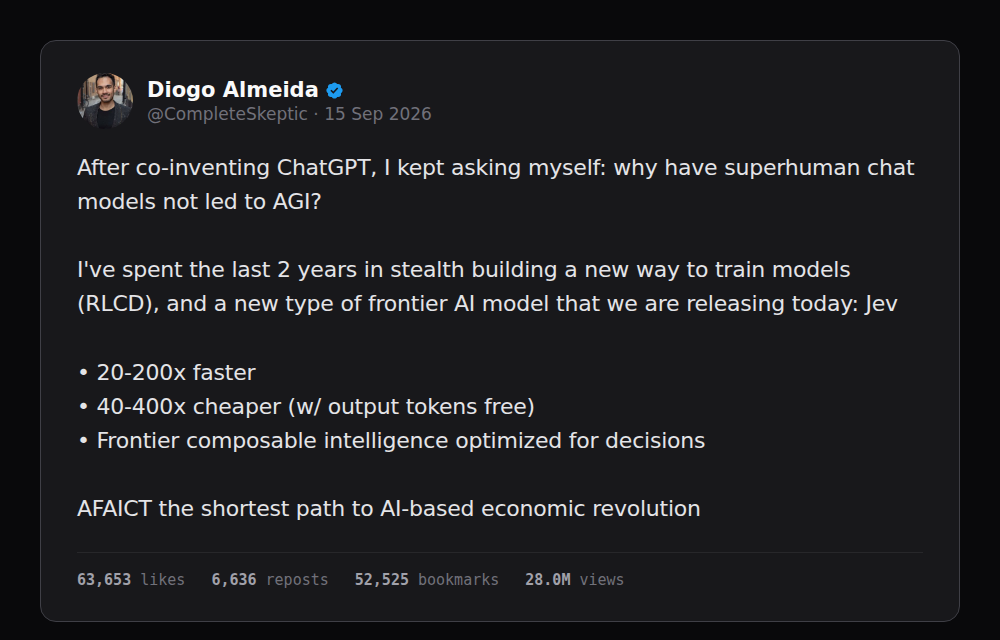
I read it twice and then sat there a while, because he had just described, in better words than I have ever managed, the thing Sarthak Wadegaonkar and I have been building since July.
Not the same product. The same idea.
We started headless on 17 July, as a fork of Sahil Lavingia's chromeless, one Swift file that gives you a browser with no interface. We wanted something else from it and drifted a long way. Two days later we shipped 1.0.1. Since then it has been most of my nights and 100 commits from Sarthak, which is close enough to half that I should stop calling it my project.
The conviction was small and we never wrote it down. Agents are bad at browsers because we make them work through channels built for people. Pixel coordinates, which drift the moment a layout shifts. Or a DOM dump pasted into a prompt, where the model pays ten thousand tokens of markup to find one button. Neither failure is the model being stupid.
So headless does not hand an agent a screen. It hands it a contract. You click by role and name, click --role button --name Continue. Page context arrives in stages, a summary first, then references like @r4 you can look inside. At the end of August a warm run cost about 174 tokens on a flow where Selenium cost 410 and Puppeteer 499, method and limits written up here.
I thought that was a niche opinion about browser automation.
Jev is not a browser tool. It is a model, and it does something I could not build in a hundred years of nights. You hand it state and some typed questions and it returns choices with probabilities attached, calibrated so the confidence tracks the accuracy. It cannot write you a paragraph, on purpose. Diogo Almeida calls it a frontier intelligence function call. The site is blunter. LLMs produce words for people, Jev produces typed decisions.
That is my sentence one layer up. His is about what comes out of the model, mine is about the world the model reaches into, and the complaint is identical. The channel between two machines should not be the one we designed for humans. He proved it with a training method. We proved it with a token count.
My first reaction was the ugly one and it lasted about ten minutes. Someone got there first, with a seed round and 28 million readers. Most people building small things feel that and then pretend they did not.
It went when I read what he had actually built. He did not get there first and neither did we. Two groups walked into the same idea from opposite ends of the stack in the same season, which is what it usually looks like when an idea is right. It stops being clever and becomes obvious, and it occurs to people who are not talking to each other.
The idea was the valuable part, and it was never ours to own.
I should be straight about scale. browser-use has 114,000 stars, Chrome DevTools MCP has 52,000, headless has none, because it is two months old and we have not asked anyone for one. Being right about a direction and having built the thing that wins are different achievements, and I have only managed the first.
So this is a thank you note. To Sahil, whose one file we forked and wandered away from, for putting it where anyone could pick it up. To Diogo Almeida, for the research, and for saying in one line what I had been circling for two months. To Sarthak, who wrote half of it and is owed a better README.
Ideas travel. If yours is any good you will meet someone else carrying it. That is not the bad news, it is the only confirmation you get.